I led the concept development for an intuitive, personalized natural language car search tool that caters to the complexity of human nature and delivers highly relevant vehicle recommendations, enriching the car buyer’s journey. Recognizing the complexity and time-consuming nature of traditional car searches, we sought to implement an AI-powered car search solution.

Challenge: Traditional search functionality is limited to binary results which do not allow for the nuance of customer needs.
Project: I led the concept development, solution design, and UI development of an AI-powered search portal.
Results: Increased stakeholder alignment & clear project direction/momentum.
My Process


User research: Binary search is killing customer loyalty
Consumers often express car preferences using subjective terms (e.g., “comfortable,” “sporty,” “family-friendly”). Traditional search is limited to binary results, failing to accommodate these nuances, which leads to user frustration and high abandonment rates.
I synthesized existing data, performed competitive analyses of major automotive sites, and analyzed user forums to pinpoint common pain points. This research confirmed the critical disconnect caused by binary filters. The findings culminated in a key hypothesis: By utilizing Natural Language Processing (NLP), we could create a more intuitive and efficient car search experience, leading to increased user satisfaction and engagement.
The hypothesis I developed was that:
“We believe that by powering the search engine utilizing Natural Language Processing will provide a more intuitive and efficient car search experience compared to traditional filter-based systems, leading to increased user satisfaction and engagement.”
Research overview (screenshot of desk research to uncover consumer painpoints)

Concept development: Building a system that learns
The core challenge was translating highly subjective customer language and sentiment into qualified, personalized machine-learning search results. We needed a system that could learn and adapt to individual search patterns.
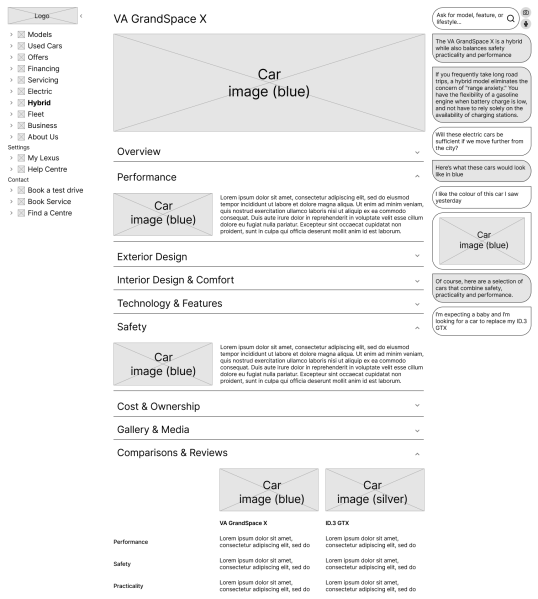
Leveraging my Google AI Vertex Platform certification, I focused on enabling true natural language queries and qualifying sentiment analysis. We developed the concept for an AI-powered search engine that could understand emotional tone. The solution was architected around four key features defined in the wireframes:
- Key features of the wireframes:
- Natural language search: Users could describe their ideal car using everyday language.
- Sentiment analysis: The AI would interpret the emotional tone of user queries.
- Preference learning: The AI would continuously refine search results based on user interactions.
- Interaction analysis: the search function would provide insight and analysis of user interactions to further enrich the experience.
Concept development (screenshot ideation of the solution wireframes)
Prototyping: Translating complex AI logic into an intuitive interface
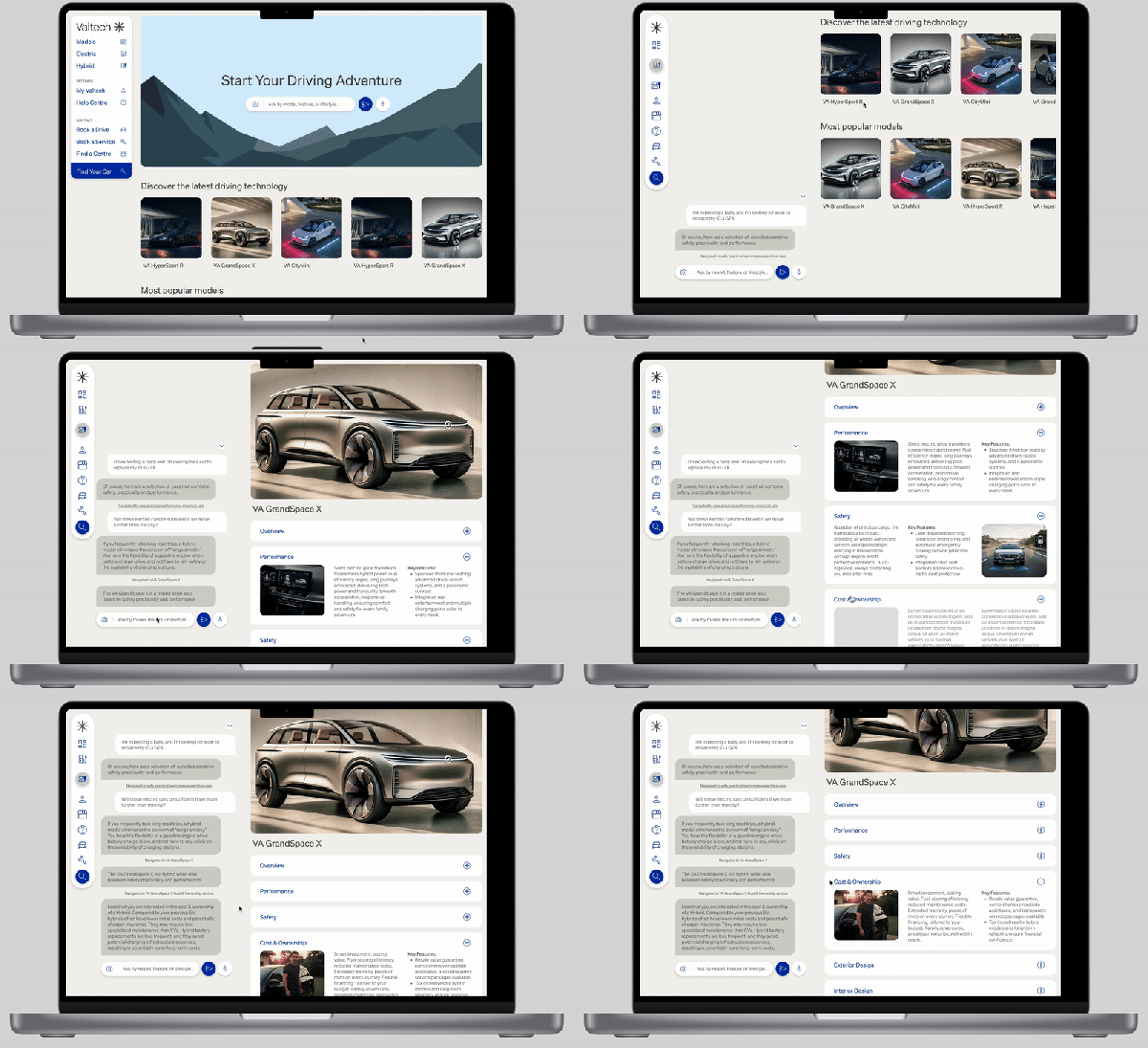
A powerful AI backend is useless without a flawless user interface. The challenge was translating our complex ideation and AI logic into a tangible, easy-to-use user experience that felt familiar yet innovative.
I meticulously translated the concept into a natural language car search UI. This involved developing detailed sketches based on existing design patterns and best practices to ensure clear and intuitive interactions. I then built a high-fidelity Figma prototype to fully demonstrate the logic and functionality. This stage was a collaborative effort, working closely with the data engineer and front-end developer to ensure the concept was technically feasible and ready for validation.
Testing: Minimizing risk by proving the design before coding
Investing in a complex AI solution carries significant risk. We needed validation that the proposed AI would deliver relevant results and that stakeholders believed in the feasibility, usability, and business impact of the concept.
To validate the engine, I developed hypothetical user scenarios, simulating various natural language queries to test the relevance of the sentiment analysis and ML results. Simultaneously, I presented the prototype and proposed features to industry experts and stakeholders, gathering essential critique on feasibility and potential impact. By applying established usability heuristics to the mockups, we proactively identified and resolved potential usability issues before moving into costly development.
Solution: Delivering a seamless, compliant and scalable design
I developed a detailed specification for the AI-powered search engine, outlining its functionality and technical requirements. I created detailed UI mockups, user flow diagrams and a prototype. The solution used Google’s Vertex AI tool to power the search and the interface was designed to meet the users’ information need both within the brand and wider information sources without overloading them or the need to leave the platform.
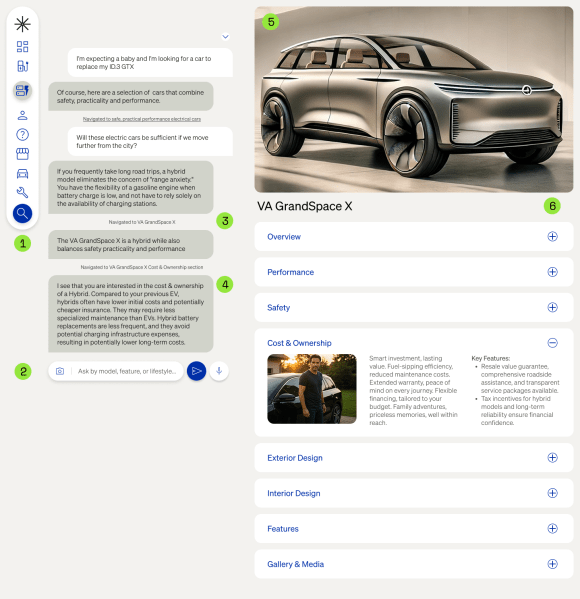
- A collapsible navigation menu to highlight the benefits of the AI search
- The options available for the customer are clearly defined above the fold
- Expandable content areas are added to give users the flexibility to choose how much detail they wish to read without adding to the cognitive load
- Infographics are added to aid users’ comprehension of the process they are in and this task’s value
- Legal requirements are included to ensure that this product meets the organization’s standards
Learnings: Data-driven design accelerated buy-in
The project had a tight turnaround, requiring an extremely efficient process to achieve critical stakeholder alignment and confidence in the design direction quickly.
This project demonstrated the significant potential of NLP to bridge the gap between human language and complex search functionalities. Crucially, the structured, desk-based concept development process proved highly effective in achieving stakeholder alignment and buy-in in a short period. It also reinforced the importance of two principles: AI-driven personalization enhances relevance, and maintaining transparency and control for users is paramount to their trust.
More projects
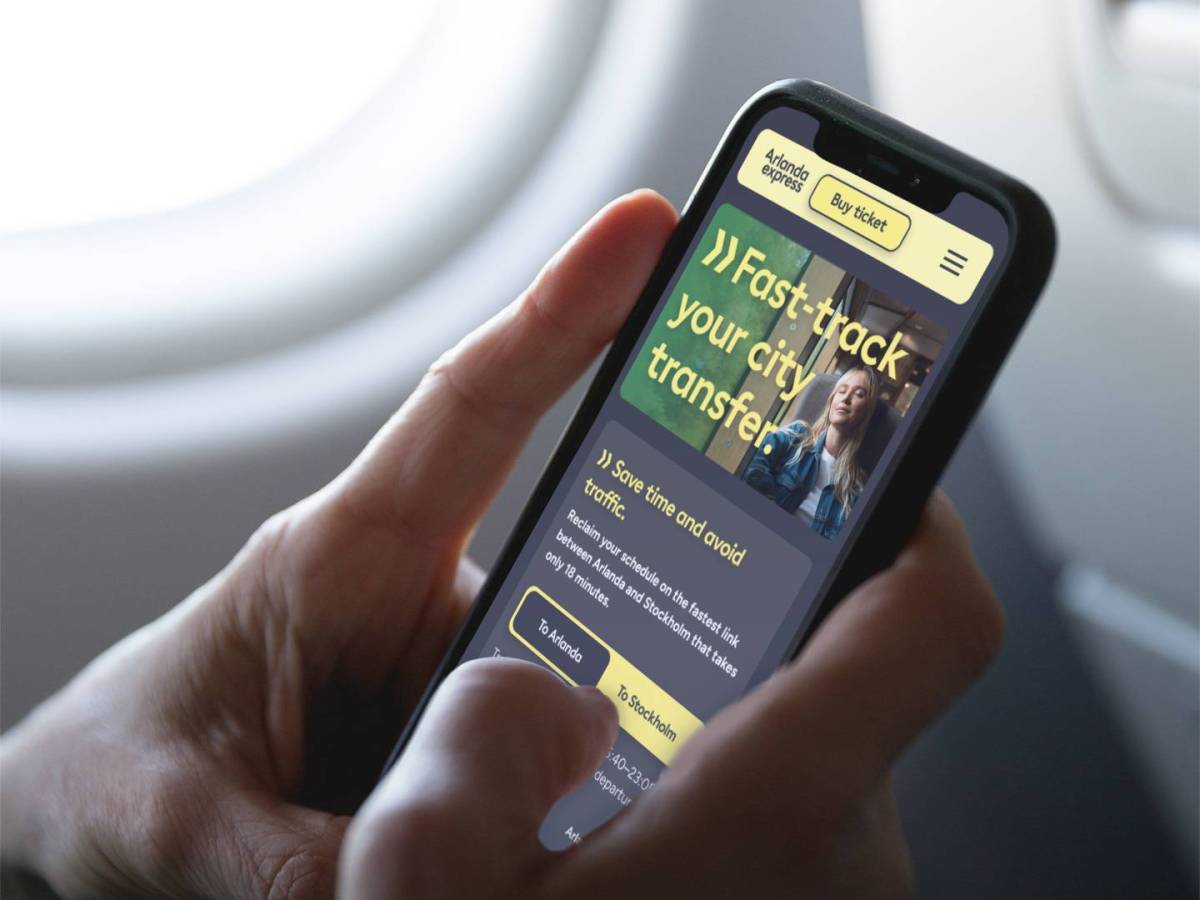
Capturing market share with data driven storytelling
I led the UX/UI design of key Arlanda express webpages to shift the conversation from price to value and convenience, thereby increasing conversion during key…
Increased productivity through accessible digitization
I reduced customers’ lead time for medical equipment delivery and reduced case worker administration with an intuitive web application. The existing process involved case workers…

Optimizing enrollment through strategic user flows
I drove the growth of jobseekers converting to suitable training opportunities on Arbetsförmedlingen’s website by creating an MVP of customizable educational paths. Before this development,…
Something went wrong. Please refresh the page and/or try again.
 Fintan Collier